
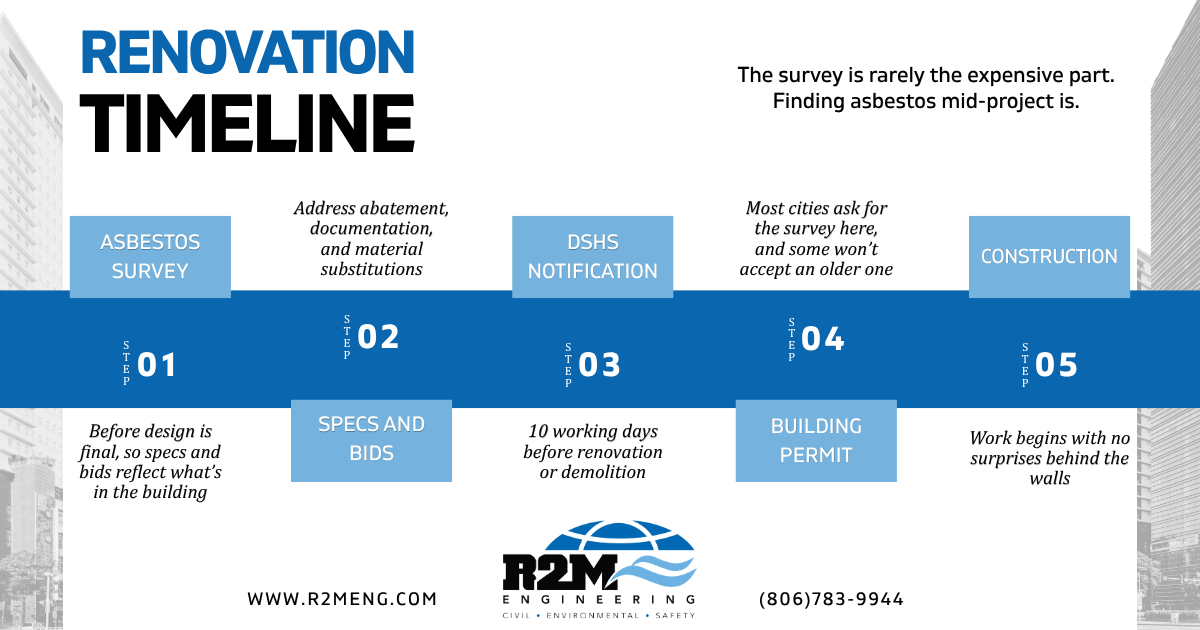
If you’re renovating a commercial building in Texas, get an asbestos survey before anyone pulls a ceiling tile, scrapes a floor, or cuts into a wall. In most cases, the law requires it, and even when it doesn’t, an asbestos survey is one of the cheapest steps in the whole project.
The survey itself is rarely the most expensive part. What costs money is finding suspect material after demolition has started. Crews stop, the permit stalls, debris that already went in the dumpster has to come back out, and someone has to figure out whether workers were exposed.
We asked Trey Rowan, who handles asbestos surveys and abatement oversight at R2M, what he sees on real projects across West Texas and what he wishes architects, contractors, and building owners knew before they called him. Trey is licensed by the Texas Department of State Health Services as an Asbestos Individual Consultant.
When do you need a survey?
For commercial and public buildings in Texas, the answer is before any renovation or demolition starts. Trey puts it plainly to contractors: “Anytime you’re going to do any kind of commercial renovation, you must have an asbestos survey. There are no ifs, ands, or buts.” The requirement covers most buildings where employees or the public spend time, including offices, retail, schools, and larger apartment complexes. Single-family homes aren’t regulated the same way, but Trey still recommends testing before a home remodel since there’s no way to know what is in older materials until they are sampled.
DSHS also requires written notice ten working days before the renovation or demolition of a public or commercial building that involves asbestos. Emergencies such as floods with structural, electrical, or sewage hazards have a shorter notification path, which we cover in the restoration section below.
In practice, most owners find out about the requirement at the permit counter. Cities often ask for the survey when you apply for a building or demolition permit, so it’s worth finding out early whether the owner already has one on file. Just don’t assume an existing survey will be accepted. Trey has had surveys sent back in both Lubbock and Amarillo because they were a few years old, including one for a building that sat vacant the entire time. If your survey is more than two years old, check with the city before you count on it.
Five assumptions people get wrong about asbestos
“Every old building has asbestos.” Older buildings are more likely to have it, but age doesn’t settle the question. Trey surveyed a building that was built in the 1920s and started life as a grocery store before becoming a pharmacy. Almost everything came back clean, and the only positive result was one type of old insulation. The owner would have paid far more for abatement than necessary if they had assumed the worst.
“You can tell by looking at it.” Occasionally you can, such as on certain pipe and boiler insulation. Most of the time you cannot because the material that matters is behind drywall, under flooring, or inside a roof system. Only lab analysis tells you for sure.
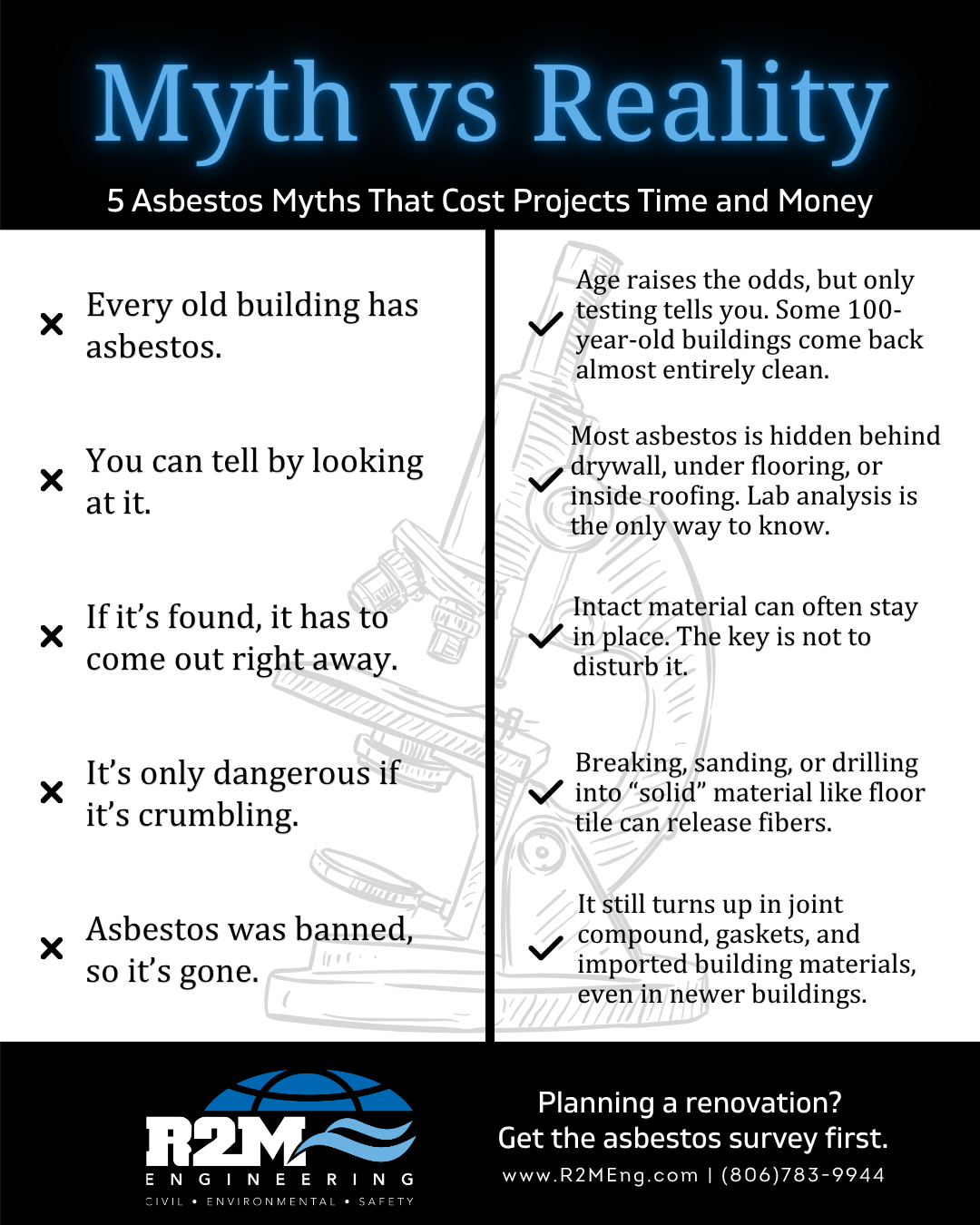
“If it’s found, it has to come out right away.” Not true. Asbestos that is intact and left alone can often stay in place. What you should not do is disturb it. Trey’s advice for a wall that tests positive is simple: don’t drill into it, don’t put screws in it, and don’t hang anything on it. Schools with asbestos in their walls use adhesive strips for posters for exactly this reason.
“It’s only dangerous if it’s crumbling.” Floor tile and many other products are considered non-friable, meaning they don’t crumble in your hand. That changes the moment someone breaks them apart, sands them, or drills into them. Drilling a single hole can release fibers that get pulled into the HVAC intake and spread through the building.
“Asbestos is gone. It was banned.” Trey hears this from clients regularly. Asbestos still turns up in products like joint compound (tape and bedding), sheet gaskets, and imported building materials from countries with less restrictive rules can contain it. A newer building is not automatically a clean building, which we come back to below.
What happens when you skip it
A contractor called Trey because the city required an asbestos survey before it would issue a building permit. By the time he arrived, most of the interior had already been removed. The drywall had been torn off, the carpet and fiberglass were piled in a corner, and the building was down to bare framing. Walking the floor with the general contractor, Trey noticed black mastic, the adhesive left behind when floor tile comes up, so he asked where the tile was. It was in the dumpster.
Trey pulled eighteen samples from what was left, and the black mastic came back positive. Because the tile in the dumpster still had mastic stuck to it, the crew had to go back through the dumpster and pull out what they could. All of the tile was double-bagged in 6-mil plastic sheeting and hauled to an approved landfill as asbestos-containing waste since it cannot go to a regular landfill. The room with the mastic also had to be abated. That job lost about a week, but a similar project was delayed for three months.
The other problem with tearing out materials first is that it often leaves nothing to test. When the original materials are gone or mixed together, the safe assumption is that they contained asbestos, so that’s how they have to be handled and documented.
On another job, the owner needed to add a paint booth to a fairly new building. The required ventilation meant cutting through the roof, so the city asked for a survey before issuing the permit. While Trey didn’t expect anything to come back positive, the mastic on the thermoplastic polyolefin (TPO) roof membrane did. Because the result was low, he recommended an additional lab method called point counting, which gives a more precise percentage. It confirmed the material was under one percent asbestos, the threshold that would have triggered abatement. Quick turnaround made a difference. Trey sampled the same day, and the report was done by Friday. When the paint booth arrived on schedule the following Monday, it was able to be installed immediately instead of sitting in the parking lot.
Anytime you’re going to do any kind of commercial renovation, you must have an asbestos survey. There are no ifs, ands, or buts.
Trey Rowan
What architects should know before the design is final
The goal is for the owner, architect, and contractor to know what they are dealing with before construction begins. On a renovation, that means having the survey in hand while the specs and schedule are still being written, not after the bids come back. Abatement is usually the most expensive piece of the asbestos process, and nobody wants to pay to remodel a space and then pay again to abate it.
On new construction and renovations alike, the specs should address asbestos directly. Many already include a line prohibiting asbestos-containing materials and requiring a letter or Safety Data Sheet (SDS) from the manufacturer or supplier. That is a reasonable step, and Trey recommends asking for SDS on all building materials. Just know its limits: a manufacturer’s statement is not a guarantee. Make the contractor responsible for collecting and keeping that documentation. Any substitutions should also go back through the architect for review since a cheaper replacement product can bring the problem back in.
It also helps to know which materials have historically caused trouble. Trey’s list starts with thermal system insulation, roofing materials (including the mastic and tar used on TPO roofs), joint compound, floor tile, and the mastic underneath it. Then there are the places nobody thinks to look. The strangest one Trey has found was black waterproofing on the inside walls of raised planter beds built over a basement. He learned to check it on one project in San Angelo and later found the same material on a job in Odessa that nobody else had flagged.
What restoration crews should do before tearing anything out
Water and fire damage still require an asbestos inspection before materials come out, but that does not mean the crew has to stand around. While samples are being collected and analyzed, the restoration team can extract water, move furniture and cabinets, and set up fans and dehumidifiers. Trey marks the samples for urgent turnaround, and results can come back in about 24 hours. In most cases there is no reason to start tearing out drywall before then, and DSHS does not look kindly on crews that do.
Sewage backups and other genuine hazards are different. When there is a risk of structural instability, electrical hazard, or sewage contamination, DSHS has an emergency provision with a much shorter notice period. Crews can start removing waste and cleaning while samples run overnight. The materials behind the walls may get damaged in the meantime, but those can be replaced.
Fire damage has its own complications. If an engineer or architect deems a building unsafe to enter, a normal survey may not be possible. In that case, everything must be handled and disposed of as asbestos-containing material, which costs considerably more. When a building can be entered safely, sampling is worth doing. After a fire damaged 16 units at one apartment complex, Trey’s samples showed the drywall and ceiling materials were positive, so the owner knew exactly what needed abatement before rebuilding.
“The building’s not that old, so we don’t need a survey”
Building age is not a reliable shortcut. The EPA’s Dealing with Debris and Damaged Buildings guidance explicitly states that structures built after 1975 may contain asbestos. Additionally, the EPA’s Guidelines for Enhanced Management of Asbestos in Buildings explains that construction dates cannot be used to rule out asbestos-containing materials (ACM).
Trey tested a building constructed in 2015 where the tape and bedding came back positive. Imported materials are a common reason: a contractor finds a cheaper product from a country with looser rules, and the savings look good until the survey results come in.
More importantly, for a commercial building in Texas, the age question does not change the requirement. The survey is needed before renovation either way, and the city will likely ask for it at permitting. Learning that the building is clean is a perfectly good outcome. It means you can move forward with confidence and the paperwork to prove it.
What to do with the survey report
Keep all of it: the report, lab results, photos, drawings, and the locations and quantities of any asbestos-containing material. The next time someone plans maintenance, repairs, a renovation, or routine operations and maintenance work, that report tells them where they can work freely and where they need to be careful. Pull out the report and share it before any of that work starts.
The report also helps you decide what to do about positive materials. Depending on their condition and your plans, there are a few different options:
- Leave them in place and manage them
- Encapsulate them with a sealant that soaks in and holds the fibers in place, but note that encapsulation does not work on already damaged building materials
- Enclose them behind new building materials
- Have them abated
Trey’s honest take is that enclosing only postpones the problem because the asbestos is still there the next time someone renovates. Abatement also gets more expensive every year. If you know a renovation is coming in the next few years, it is usually cheaper to plan abatement now than to put it off.
If you sell a commercial building, the survey should go to the new owner. Abatement is expensive enough that buyers need to know what they are inheriting and keeping a complete record protects you as the seller.
How R2M can help
R2M performs asbestos surveys for commercial, public, and multifamily buildings across West Texas, and we provide abatement oversight when positive materials need to come out. During abatement, our portable in-house lab runs phase contrast microscopy (PCM) air monitoring, so results come back quickly without waiting on a shipment. PCM counts airborne fibers but cannot tell asbestos apart from fiberglass or carpet fibers, so some projects, including clearance testing at K-12 schools, require a more specific method called TEM. When a project needs it, we send those samples to an accredited outside lab.
Not every building requires abatement, and sometimes the right answer is a clean report or a material that tests under the threshold. Either way, the survey is where the answer starts. If you’re planning a renovation and are not sure what you need, reach out to Trey at trowan@r2meng.com or 806-783-9944.


This post is general information. Requirements vary by building type and city, so confirm with DSHS or your local permitting office.