
A while back, we received a call from a property owner whose neighbor said their fence was in the wrong place. What initially sounded like a straightforward boundary question raised a much bigger concern.
When the owner purchased the property, the seller walked them along a fence line and explained that it was the boundary. They shook hands, closed without a survey, and started building.
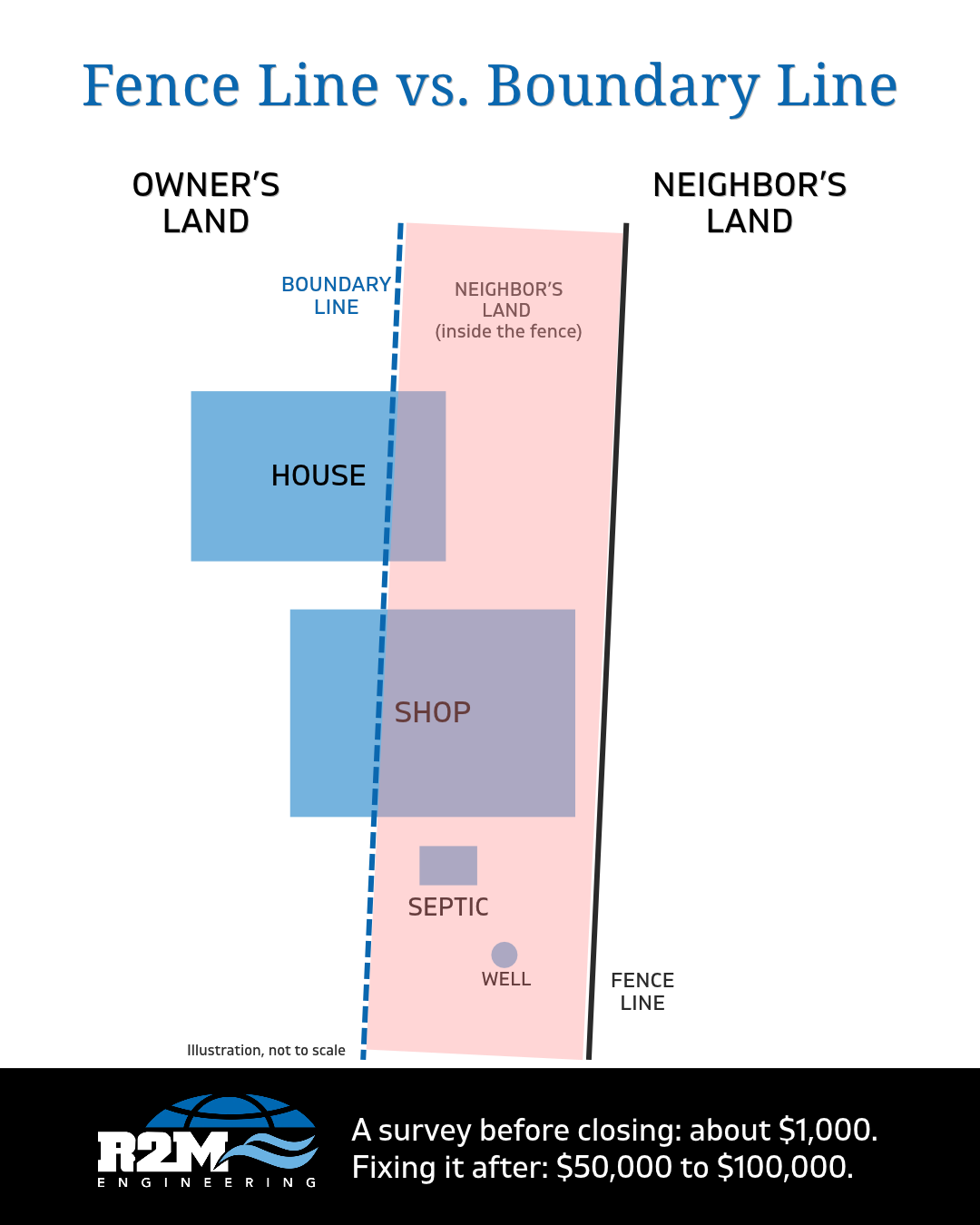
By the time we were contacted, a new home, a concrete slab for a large shop, a septic system, and a water well were already in place. The owner believed these improvements were within the land they had purchased.
Our preliminary review of the deed and available records raised serious concerns about the relationship between the documented boundary and the fence line the owner had relied on. If those concerns were confirmed, the implications could extend well beyond the original disagreement with the neighbor.
For the owner, this was no longer simply a fence location question. It was a question of whether substantial investments had been made based on an incorrect understanding of the property boundary. To move forward, the owner could try to buy the land they’d built on from the neighbor, or move the house, pour a new slab, relocate the septic, and drill a new well. I’d estimate that second option would cost somewhere between $50,000 and $100,000 while a boundary survey before closing would have run around $1,000.
The owner wasn’t happy with what we told them, and I get that. But, sometimes, the job is to deliver facts, not tell people what they want to hear. That is an uncomfortable situation for any property owner to face. It is also why understanding property boundaries before purchasing land or beginning construction can be so important.
Surveyors should not be considered as advocates for a particular client or position.
Brown’s Boundary Control and Legal Principles, 7th ed., Chapter 1
A Fence Is Not Necessarily a Property Boundary
One of the most common assumptions in rural property ownership is that the fence marks the property line. It’s an understandable assumption. Fences divide pastures, hold livestock, separate yards, and stand between neighbors for years.
But a fence is a physical feature, not automatic proof of the legal boundary.
A fence may have been built along the property line, but it may also have been placed for convenience, built from a rough estimate, or inherited from a previous owner’s understanding of the boundary. Sometimes a fence reflects a long-standing arrangement between neighbors rather than the boundary described in the property records. In West Texas, plenty of fences went up to keep cattle in, not to mark anything legal.
This distinction matters because the physical use of land and the legal boundary do not always coincide. A fence can stay in the same place for decades without that fact alone establishing ownership of the land it encloses.
What a Survey Can and Cannot Tell You
A boundary survey involves more than measuring the distance from one fence corner to another. The surveyor evaluates the property description, available adjoining property records, existing monuments, physical evidence, and other relevant information to develop a professional opinion regarding the boundary’s location. In Texas, a survey is the only way to find out where a boundary actually is on the ground.
The survey can then document how that boundary relates to existing features, including fences, buildings, driveways, and other improvements. If the fence is located offline of a boundary, the survey can show the discrepancy.
Those findings matter but do not automatically settle every question of ownership. Long-standing occupation can introduce other legal considerations. For example, Texas law recognizes adverse possession under specific circumstances, and other boundary-related claims can depend on the history of a particular property. The age of a fence, by itself, does not establish that ownership has changed. In a recent Texas case, a barbed-wire fence that had stood since 1965 was not enough to give a family 42 acres outside their deed lines.
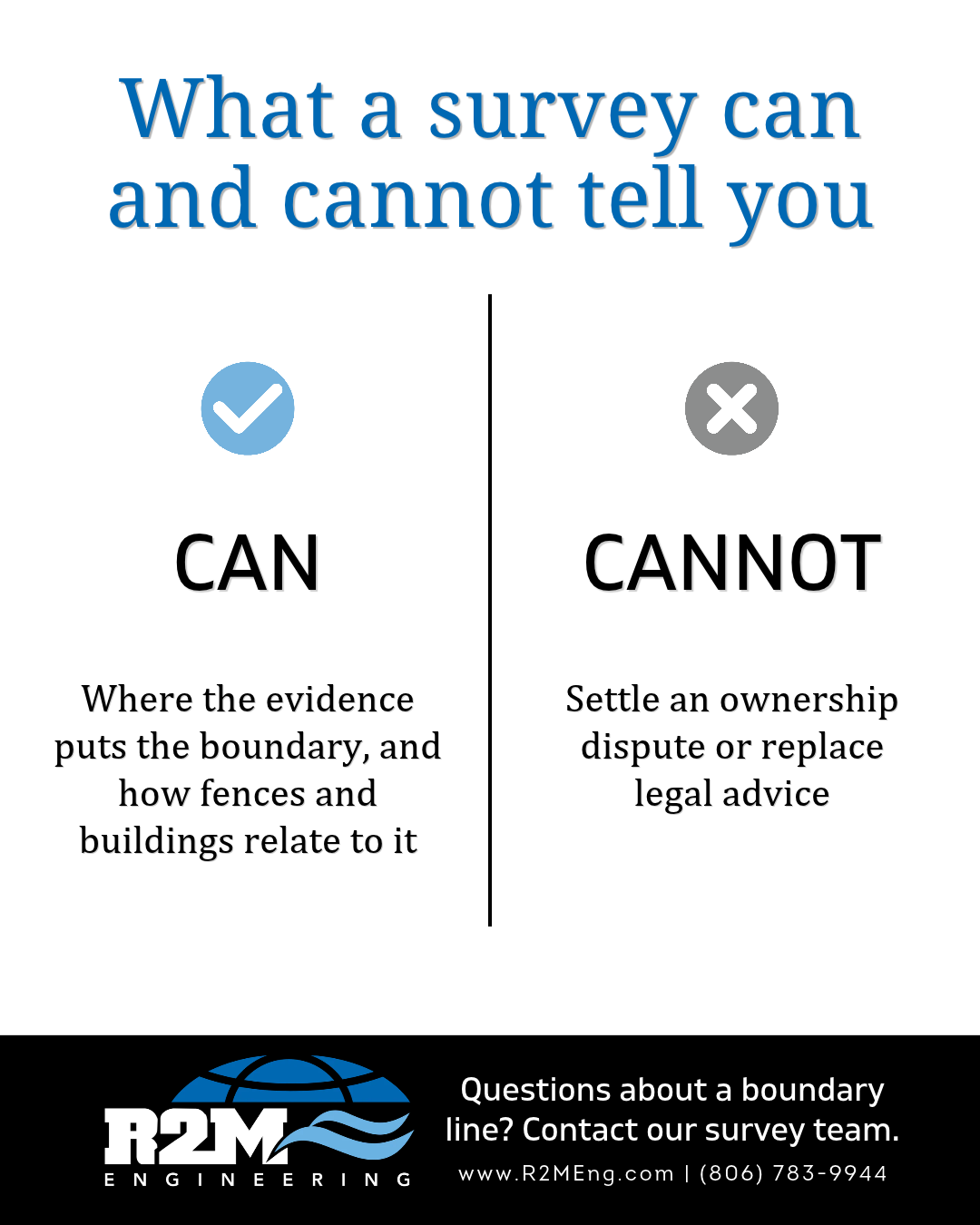
When a discrepancy raises questions about competing ownership claims or legal rights, an attorney may need to evaluate the circumstances and advise the parties on potential remedies. The surveyor’s role is to investigate and document the boundary evidence, not to settle a legal dispute. We will tell you where the evidence puts the line. A lawyer tells you what you can do with that evidence.
That distinction helps owners avoid two costly assumptions: that a fence must mark the boundary simply because it has always been there, or that a survey showing a discrepancy automatically settles everything.
When Should You Consider a Boundary Survey?
If you’re buying acreage, the short answer is before you close. A boundary survey is particularly valuable before you plan construction near a property line, install utilities or a septic system, or make major improvements to land with uncertain boundary evidence.
It can also help when a neighbor questions a fence location or when existing improvements appear close to a property line. Identifying a potential discrepancy before construction may give the parties more options for investigating and addressing the problem.
The appropriate scope of surveying services depends on the property, the records available, what you plan to build, and what questions need answering. Not every transaction requires the same level of investigation, and a survey is not a guarantee against every title defect or future dispute. However, obtaining appropriate boundary information before making major investments can help a buyer make a more informed decision, and it costs a lot less than finding out the hard way.
Before You Rely on the Fence
A fence is easy to see. The boundary it is intended to represent may be much harder to establish.
When you are buying property, ask the seller if they have an existing survey; if not, get one. When you are planning improvements, make sure the proposed work actually fits within the property boundaries shown on the survey.
In our experience, the most difficult boundary conversations happen after an owner has already invested substantial time and money in a piece of land. We would much rather have that conversation with you before you close.
A boundary survey cannot guarantee that every property dispute will be avoided, and it cannot replace legal advice when ownership is contested. What it can do is provide important information about the location of the boundary and whether what you’ve built, or plan to build, is on the right side of it.
If you have questions about a property, reach out to Jason at jbrewer@r2meng.com or 806-783-9944.

The information provided in this article is for general informational and educational purposes only and should not be construed as legal, surveying, engineering, or other professional advice. Every property, project, and circumstance is unique, and applicable requirements, regulations, and conditions may vary depending on the location and specific facts involved. The information presented should not be relied upon as a substitute for professional consultation or an evaluation of your particular situation. Readers are encouraged to consult with qualified professionals, including a licensed professional land surveyor or legal counsel, as appropriate, before making decisions or taking action based on the information discussed.